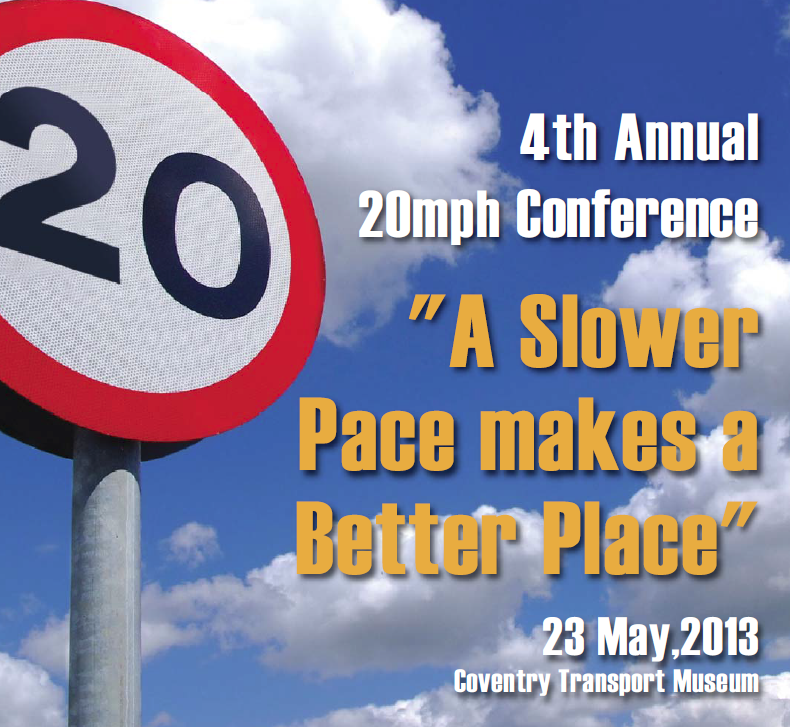
Journalist John Morrison, a cycling campaigner from Kent, gives a personal view of the 4th annual 20 mph conference, which took place in Coventry on 23 May
We journalists like reporting events, not processes. One day things are black, the next day they’re white. When something decisive happens, we know how to write the before-and-after story.
Reporting a process, such as the gradual spread of 20 mph speed limits on urban streets over the last five years, is more difficult. It’s an under-the-radar story that isn’t black and white – more like fifty shades of grey, with the sexy bits left out. Social behaviour and expectations change imperceptibly, and then reach a tipping point at which the prevailing norms change. Drink-driving and smoking are examples of behaviour which used to be acceptable 50 years ago, but are now taboo. The opposite has happened for same-sex relationships. Finally the law catches up, and everyone wonders why it all took so long.
The annual conference on 20 mph limits, which I attended for the first time in 2012, gives an opportunity to take a snapshot of a process which is largely unnoticed by the national media. Permitted rather than actively led by central government, local authorities are moving at their own pace to lower the standard 30 mph limit which has applied for decades on most urban streets. A year ago, the headline figure was that 8 million people in the UK lived in local authorities committed to 20 mph limits; now the figure is 12 million.
The change is happening much faster in cities and unitary authorities than in the rural shires. Lancashire is the only county to take the plunge so far, but the pace seems to be quickening. Rod King of 20’s Plenty for Us, points to a new circular on speed limits issued in January 2013 from the Department for Transport, which encouraged the switch. ‘This is a very clear push from the DfT,’ he says. ‘They have recognised that this is about the wider benefits, not just road safety.’
Reducing casualties remains the key justification, but public health, which since April 2013 is the responsibility of local authorities rather than the NHS, is now emerging as a central driver for change. The spiralling costs of our national obesity epidemic can best be reduced by getting people to walk and cycle more. Bristol reported rises of more than 20% in walking and cycling after making the change. The economic case for 20 mph limits used to be based solely on statistics for casualty and crash reduction, but now the health benefits loom larger. As a cycling campaigner, I have always been convinced that high traffic speeds are the biggest single obstacle to getting more people on to their bikes.
Humps are over
20 mph limits used to involve ‘zones’ with expensive traffic calming, but the last government eased the rules, opening the door to making the change over much wider areas, with just a minimum of signage. The costs have fallen sharply, and local authorities find it cheaper than they expected. Campaigner Anna Semlyen, a councillor in York and a health economist, says Lancashire spent £6 million rather than the budgeted £9 million. ‘York is spending £3 a head. In Middlesbrough it was £1.80 a head – a bargain.’
Lower limits are proving popular with businesses, which need more footfall to compete with online retailers. There are also claims that house prices rise by 10% on streets where 20 mph limits replace 30 mph limits, even if the actual traffic speeds fall by a smaller amount. Satisfaction among residents seems to be high, with lower noise levels and pollution. Local politicians, at least in cities, now see the way the wind is blowing.
One useful aspect of the annual 20 mph conference, organised by transport training specialists PTRC, is that it gives a platform not just to supporters of lower limits but also to independent academics and even to those who disagree. The 20’s Plenty for Us movement is clearly influential, but this is a forum for local authority officers and engineers to find out what’s going on, not a campaigning rally.
20’s Plenty for Us steers a carefully neutral political course, and defines itself not as a Westminster-focused lobby group but as a national voluntary organisation supporting communities who want lower traffic speeds. This low-key approach seems to be paying dividends in opening doors to local authorities of all political colours.
Rod King’s current scenario is that a foreign tourist could arrive at St Pancras and travel by rail to Oxford, Bristol, Liverpool, Edinburgh, York, and Cambridge, then back to London, and find 20 mph limits in each historic city. The dots on the map, once few and far between, are spreading.
It would be wrong to imagine that all the obstacles to 20 mph limits have miraculously vanished. Emma Sheridan of (Green-led) Brighton and Hove city council told the conference that support for the lower limits introduced in April 2013 was 55% with 45% against, with taxi drivers particularly opposed. ‘It has been highly political, but we have cross-party support.’ Brighton has been bolder than other cities by exempting only a few A and B roads from the 20 mph limits. Local police have ‘not been very supportive’, in her words. Emotions seem to be running higher than elsewhere.
Police now ready to enforce 20 mph
At last year’s conference, a representative of the chief police officers’ club ACPO got a frosty reception when he explained why police were reluctant to enforce 20 mph limits. That attitude has now softened; ACPO now says that where drivers are regularly and wilfully breaking the law ‘we would expect that officers will enforce the limit and prosecute offenders.’
Rod King’s view is that while every police force faces budget cuts, ‘There is a gradual realisation in the police that it’s not going to go away. This is the way our roads are headed, and there are heads coming out of the sand.’ However, the expectation is that the pressure for lower traffic speeds has to come from community involvement. Occasional enforcement by police is necessary, but is only a part of the mix. ‘This is about everybody playing their part.’ The 20’s Plenty for Us movement now has 197 local campaigns, 70 more than a year ago, with local councillors leading the way. The shift in mood has parallels in other EU countries, where 30 kph default limits have won support in the European Parliament and are the subject of an international petition to force the European Commission to act.
The Coventry conference heard research reports, some of them highly technical, which appeared to undermine some of the most frequent objections to 20 mph limits. According to Duncan Kay of research consultancy Ricardo-AEA, claims by motoring organisations that lower limits will lead to higher emissions and fuel consumption should be treated with caution. In fact the opposite may be true, and in the long run a modal shift towards walking and cycling will undoubtedly cut pollution.
Catherine Purcell of the University of South Wales reported on research into how poorly children and old people judge vehicle speeds. The ability to tell how fast an approaching car is coming appears to be strongly age-related – which implies that lecturing primary school pupils on road safety won’t necessarily protect them. ‘It’s not enough to get children to pay attention – it is a matter of maturity in perception.’
Blackburn’s director of public health Dominic Harrison highlighted ‘very powerful guidance’ from NICE (now the Health Development Agency) on the need to involve health professionals in tackling transport and traffic issues, especially the high level of child casualties and the low level of physical activity in deprived areas.
Tipping point approaching?
At some point in the next few years, the proverbial tipping point in the process is likely to arrive. Rod King’s estimate is that with public opinion firmly in favour of 20 mph limits (75% support them, according to the British Social Attitudes survey), the government will sooner or later have to adjust its benevolent but essentially laissez-faire policy of letting each local authority do its own thing.
‘We are in a transition from a situation where the norm in our towns and cities was 30 mph, with some special places where we would slow down. We are in transition towards 20 mph being the norm. Already in some of our iconic cities, the 30 mph streets constitute less than 10% of the total.
‘How can we have a national limit of 30 mph with any credibility when so many of our cities have rejected it out of hand as only being suitable for a small minority of their roads? 20 mph is no longer the exception but the norm in so many places.’
He argues for a change in the DfT signage regulations – not to make 20 mph compulsory everywhere, but to make it cheaper to introduce. Instead of the current situation where repeater signs are required on all 20 mph roads, 20’s Plenty for Us wants the rule changed to require such signs on 30 mph roads instead. ‘This would still allow local discretion, you can still have the whole of your town at 30 mph, but you pay for the repeater signs.’
The DfT has announced a review into road signage. My guess is that at some point in the next five years it will have to climb off the fence and clarify what the national policy really is, to avoid a confusing postcode lottery of varying limits on urban streets. That will be the moment when the process turns into an event. In journalistic terms, it will be a story.